About the Journal
PEARL – A Multidisciplinary Research Journal is a peer-reviewed publication by St Philomena College, Puttur, an autonomous institution affiliated with Mangalore University and managed by the Catholic Board of Education, Mangalore. Established in 1958 by the visionary Fr. Antony Patrao, the college has continually upheld its mission of transforming society through academic excellence and community empowerment.
Recognized by the University Grants Commission (UGC) and the Government of Karnataka, the institution holds prestigious credentials including AICTE approval, ISO 9001:2015 certification, NAAC accreditation, and a 3-Star rating from the Ministry of Human Resource Development (MHRD), Government of India. It is also a designated Research Centre by Mangalore University and an innovation hub under the NAIN Project (Department of IT & BT, Government of Karnataka).
PEARL serves as an intellectual platform for researchers, academicians, and practitioners to publish original, high-quality research. The journal fosters interdisciplinary collaboration and is committed to promoting impactful studies that contribute to the scientific, economic, and social development of the global scholarly community.
Scope of the Journal
The journal invites scholarly contributions in the following disciplines:
- Commerce and Accounting
- Management
- Physics
- Social Work
- Economics
Through PEARL, St Philomena College aims to bridge the gap between academia and innovation, encouraging progressive discourse and sustainable research development
Current Issue
Issue Description
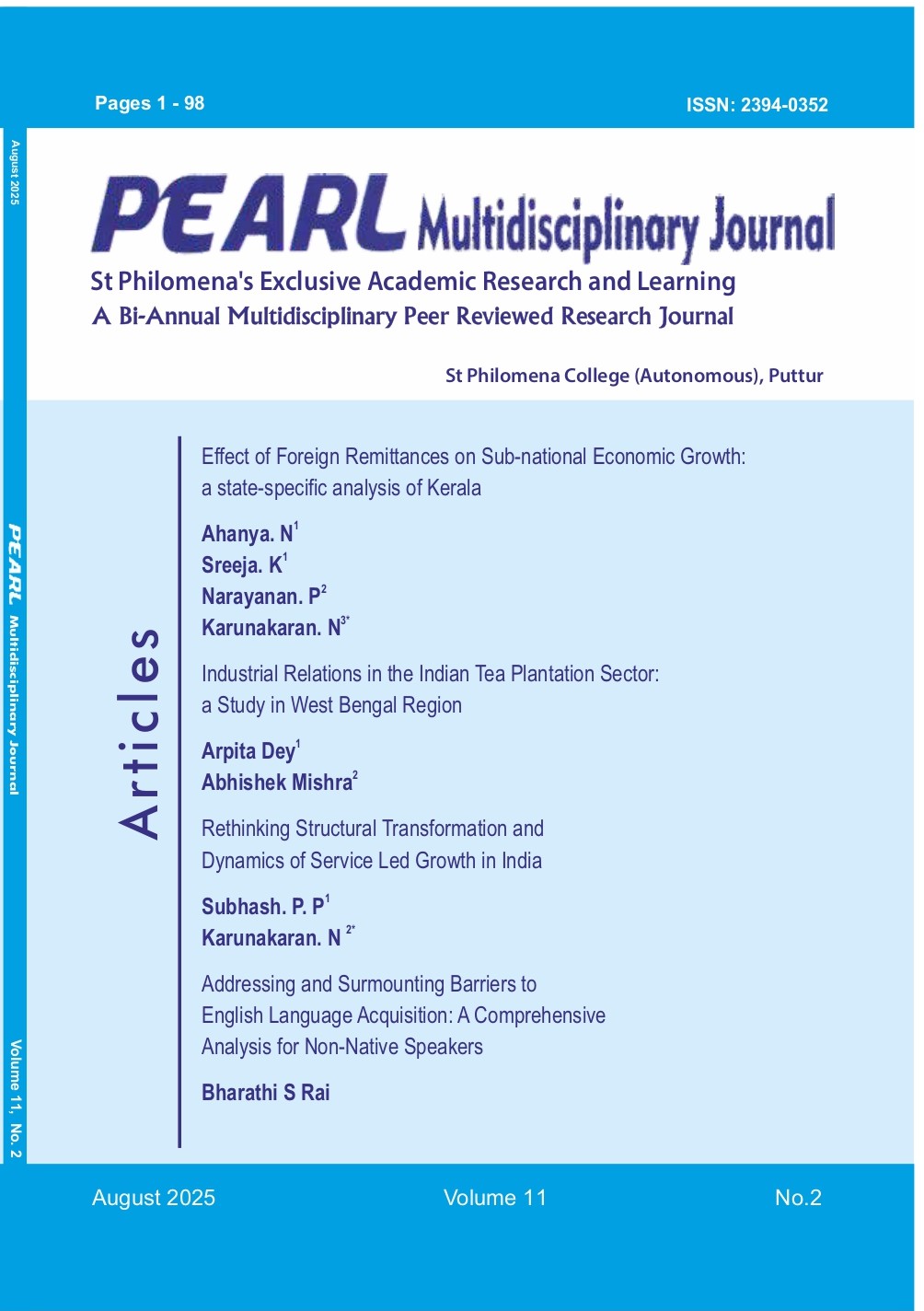
This journal issue brings together scholarly contributions that examine key socio-economic and developmental challenges within the Indian context, with a particular emphasis on regional growth dynamics, labor relations, structural transformation, and educational advancement. The articles collectively highlight how economic structures, institutional frameworks, and social factors influence development outcomes across different sectors and regions of India.
The first article, “Effect of Foreign Remittances on Sub-national Economic Growth: A State-specific Analysis of Kerala,” explores the significant role of international remittances in shaping regional economic performance. By focusing on Kerala, a state historically dependent on migrant remittances, the study evaluates how inflows of foreign earnings contribute to income generation, investment patterns, and broader economic growth at the sub-national level.
The second article, “Industrial Relations in the Indian Tea Plantation Sector: A Study in the West Bengal Region,” examines the dynamics between employers, workers, and labor institutions within one of India’s traditional plantation industries. The study provides insights into labor conditions, collective bargaining practices, and policy implications for improving industrial harmony and worker welfare in the tea plantation sector.
The third contribution, “Rethinking Structural Transformation and Dynamics of Service-Led Growth in India,” revisits the evolving pattern of India’s economic transformation. The paper critically analyzes the increasing dominance of the service sector and its implications for employment generation, productivity growth, and long-term development strategies in a rapidly changing economic landscape.
The final article, “Addressing and Surmounting Barriers to English Language Acquisition: A Comprehensive Analysis for Non-Native Speakers,” focuses on educational development and linguistic accessibility. It identifies the structural, psychological, and pedagogical challenges faced by non-native English learners and proposes strategies to improve language acquisition and communication competence in diverse learning environments.
Together, these articles contribute to a deeper understanding of India’s development trajectory by examining economic growth, labor relations, structural economic shifts, and educational barriers. The issue aims to stimulate further research and policy discussion on inclusive and sustainable development across sectors and regions.
Articles